Living in Union City
Union City anchors the southwestern corner of Fulton County, positioned along major arterial corridors that connect residents efficiently to downtown Atlanta, Hartsfield-Jackson, and the employment centers spread along the I-285 ring.
The city’s residential neighborhoods carry a settled, community-rooted quality built over decades of homeownership, with block associations and neighborhood institutions that give Union City its own civic character and local identity.
Flat Shoals Road and the surrounding commercial corridors support local retail and daily services, while Cochran Mill Road to the west opens into the more pastoral landscape of south Fulton’s protected greenway system.
Regional parks and natural areas within easy reach offer open space and wooded trails, giving residents a counterbalance to the city’s commercial energy and access to south Fulton’s quieter rural edges to the west.
Lifestyle
Daily life in Union City moves between the convenience of accessible suburban amenities and the community culture of a mid-sized city with a long residential history and well-established local institutions.
Cochran Mill Park and the surrounding natural areas draw residents who prefer creek corridors and forested trails over formal park infrastructure, finding that south Fulton’s natural landscape rewards those willing to explore it fully.
The Flat Shoals corridor provides practical access to everyday needs, while the Camp Creek commercial area to the north offers a wider retail and dining selection when residents are looking for additional variety.
Union City’s compact geographic footprint makes it one of the more navigable communities in south Fulton, with most daily destinations reachable without extensive driving or significant time spent on congested arterials.
History of Union City
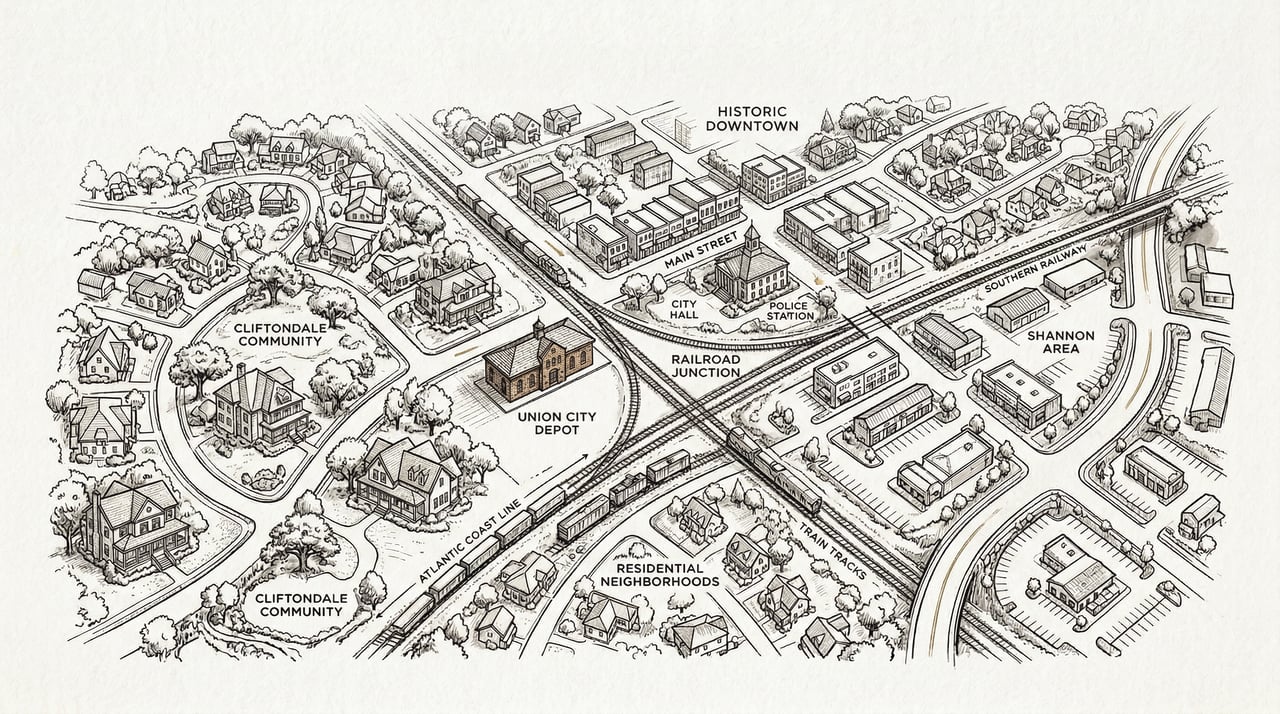
Union City traces its civic roots to the post-Civil War era, originally known as Mason’s Station after the railroad stop that established early commercial and residential activity along the Atlanta-LaGrange rail line.
The community incorporated formally in 1908, its early growth driven by the regional rail network, agricultural trade, and a steady influx of families seeking affordable land on Atlanta’s southwestern agricultural edge.
Through the twentieth century Union City developed a full institutional fabric of churches, civic clubs, and community organizations that formed the backbone of a tightly knit city centered on family, land, and neighborhood life.
Annexation and boundary expansion in later decades extended the city’s footprint into surrounding Fulton County land, evolving Union City into a full-service municipality with its own parks system, city hall, and civic identity.
Dining and Local Favorites
- Southern Table Union City — a locally owned dining destination along the Flat Shoals corridor where the kitchen focuses on Southern-influenced comfort food and daily specials reflect a deep familiarity with regional flavors.
- Georgia Bob’s Barbecue — a south Fulton barbecue staple delivering slow-smoked meats, housemade sides, and a straightforward dining experience that draws loyal regulars from Union City and the surrounding county.
- Nuevo Laredo Cantina — a south Fulton outpost of the beloved Atlanta Mexican kitchen, drawing residents for its handcrafted margaritas, house-smoked meats, and a festive dining atmosphere suited to family and group gatherings.
- Grub Burger Bar — a reliable stop along the Camp Creek corridor delivering elevated burger builds and quality sides in a clean, well-run environment drawing Union City residents for casual weekend meals.
Parks and Green Space
- Cochran Mill Park — a large Fulton County natural area with waterfall trails, creek crossings, and dense hardwood forest accessed from the Cochran Mill Road corridor west of the city center.
- Flat Shoals Park — a community park along the Flat Shoals corridor offering open recreational fields, walking paths, and shaded picnic facilities for Union City residents across all seasons.
- Camp Creek Greenway — a linear trail corridor running along Camp Creek, connecting residential areas to natural open space through one of south Fulton County’s most accessible and well-maintained greenway networks.
Daily Life
The Flat Shoals Road corridor anchors Union City’s daily shopping with a full-service Publix and a series of neighborhood-serving retailers that keep essential provisioning close to most residential addresses without requiring extended travel on congested arterials.
The Camp Creek Marketplace corridor to the north adds deeper commercial reach for residents seeking expanded dining and retail selection, with the entire stretch accessible within a short drive of the city center.
Locally owned service businesses and community-anchored establishments give Union City’s commercial identity a genuinely neighborhood-scaled character, where most practical daily needs resolve within the city limits rather than requiring travel to adjacent communities.
FAQs
What is the overall feel of Union City?
Union City has the grounded, community-oriented character of a city that has been building its identity from within for more than a century, with neighborhoods shaped by long-term homeowners and civic institutions rather than speculative development. The pace is accessible and human-scaled, with a south Fulton sensibility that values stability, community connection, and a genuine sense of place over surface-level amenities.
What home styles are most common here?
Union City’s housing stock includes a mix of brick ranch homes and traditional suburban builds from the post-war decades, alongside newer construction developments that have expanded the city’s residential inventory in recent years. Lot sizes tend toward the generous side for a south Fulton community, and many homes include mature landscaping and rear yard space well suited to outdoor living and family use.
What makes Union City appealing for lifestyle buyers?
Union City appeals to buyers who prioritize accessibility, community rootedness, and south Fulton’s improving infrastructure without the pricing premium of more established intown or northern corridor addresses. The proximity to Hartsfield-Jackson, a strong natural park system at Cochran Mill, and the city’s genuine neighborhood character make it a practical and community-centered lifestyle choice.
What does a typical day look like in Union City?
A typical Union City day moves efficiently, with daily shopping anchored along the Flat Shoals Road corridor and natural recreation available at Cochran Mill Park within a short drive to the west. Evenings are often spent at home or within a neighborhood setting, with the broader Camp Creek commercial area providing dining and social options when residents want to venture out.
Is Union City a strong long-term ownership or investment choice?
Union City offers an accessible entry point into Fulton County real estate with proximity to Hartsfield-Jackson’s substantial employment base and south Fulton’s ongoing infrastructure investment along key commercial corridors. For buyers focused on long-term positioning in a south metro market with strong employment anchors and community stability, Union City represents a grounded and practical ownership option.