Living in Peachtree City
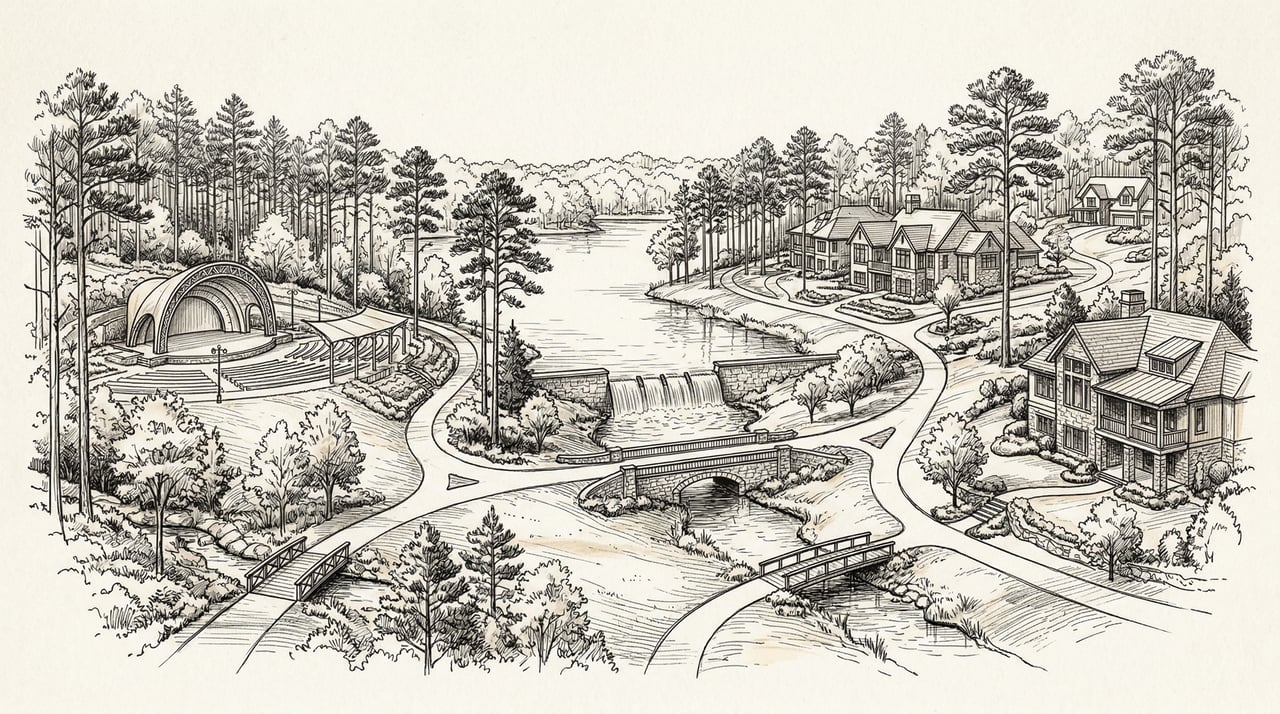
Peachtree City is one of the most deliberately designed communities in the Southeast, built from a master plan that placed lakes, parks, and more than 100 miles of multi-use cart paths at the center of residential life.
The city's five villages, each with its own retail node and character, create a layered sense of neighborhood identity that few planned communities in the country have managed to sustain over several decades.
Lake Peachtree and Lake Kedron anchor the landscape visually and recreationally, offering residents a continuous relationship with water that shapes the morning light, the weekend pace, and the feel of outdoor entertaining.
The corridor along Highway 74 carries the city's commercial life, but most residents experience Peachtree City primarily from the cart path network, which connects homes to schools, shops, and open space without a single intersection.
Lifestyle
The golf cart is not a novelty in Peachtree City. It is the primary mode of daily movement for many residents, used for school drop-offs, grocery runs, dinner reservations, and evening rides along wooded cart path corridors.
Tennis, pickleball, and open-water recreation on the city's lakes give residents a broad range of active pursuits without leaving the city, and the network of trails supports both casual walkers and serious cyclists year-round.
The city's amphitheater at Drake Field and its proximity to the Piedmont Newnan Hospital corridor lend Peachtree City an infrastructure depth that most communities of its size cannot match.
Social life gravitates toward the waterfront, the cart path intersections near shopping nodes, and the outdoor dining terraces that have become a defining characteristic of the city's more active commercial corridors.
History of Peachtree City
Peachtree City was founded in 1959 by a group of developers who envisioned a self-contained planned community in rural Fayette County, a concept that was considered experimental at a time when the Atlanta suburbs had barely reached the county's northern border.
The master plan, which reserved significant acreage for green space and connected the city's residential villages through a non-vehicular path system, was influential in the national conversation about planned community design throughout the 1970s and 1980s.
Over the following decades, Peachtree City attracted corporate campuses and light industrial development along its business corridors, bringing employment and economic stability that reinforced the city's identity as a self-sustaining community rather than a bedroom suburb.
The residential architecture spans the full arc of its development history, from the ranch homes and split-levels of its earliest villages to the larger estate-style builds that appeared along the lakefronts as the city matured through the 1990s and 2000s.
Dining and Local Favorites
- Line Creek Brewing Company — a locally rooted craft brewery with a relaxed taproom, a rotating seasonal beer list, and a cart-path-accessible location that draws a consistent neighborhood crowd on weekends.
- Ippolito's Family Style Italian — a long-standing Atlanta-area Italian restaurant with a Peachtree City location that serves generous portions of pasta and regional Italian classics in a warm, family-oriented room.
- The Brakeman — a popular local bar and kitchen near The Avenue known for craft beers on tap, elevated pub fare, and a lively but comfortable atmosphere popular with young professionals and families alike.
- Sconyers of Peachtree City — a reliable neighborhood spot offering Southern comfort food and a comfortable dining room that fills steadily on weekday lunch breaks and weekend family dinners.
- Aqua Terra Bistro — a more refined dining option in the Peachtree City corridor, drawing residents for date nights and celebratory dinners with a menu that shifts with the seasons.
Parks and Green Space
- Lake Peachtree — the city's largest and most iconic body of water, ringed by a cart path and open greenway, popular with kayakers, anglers, and evening strollers throughout the warmer months.
- Line Creek Nature Area — a wooded preserve on the Fayette-Coweta county line with quiet forested trails, creek crossings, and a natural character well removed from the city's more developed corridors.
- Glenloch Recreation Complex — a well-equipped community sports and recreation hub anchoring one of the city’s residential villages, with courts, fields, and open green space used throughout the week.
- Drake Field Amphitheater — a broad open-air venue and park where residents gather for outdoor performances, community events, and casual recreation in a setting that captures the spirit of the city’s original planning vision.
>
Daily Life
Grocery and daily essentials are well handled in Peachtree City, with a Publix anchoring several village retail nodes and local coffee shops like Cafe Kili providing a reliable morning gathering point accessible by cart path from most neighborhoods.
The Avenue Peachtree City lifestyle center brings together national retailers and locally owned boutiques along a walkable open-air streetscape, giving residents a satisfying range of shopping without requiring a drive into the broader metro.
Wellness options in Peachtree City are unusually well developed for a city of its size, with multiple boutique fitness studios, yoga practices, and med-spa providers along the Highway 74 corridor catering to a health-conscious and active resident base.
FAQs
What is the overall feel of Peachtree City?
Peachtree City feels like a community that has succeeded at its original ambition — a place where people live differently because the infrastructure makes a different kind of daily life possible. The cart path culture, the lakes, and the preserved green space give the city a warmth and vitality that is immediately apparent to anyone who spends time there.
What home styles are most common here?
Peachtree City’s housing stock reflects its decades-long development arc, ranging from compact ranch homes and split-levels in the earlier villages to larger traditional and craftsman-style homes closer to the lakefronts. Estate-scale properties with private lots and water views are available at the upper end of the market, particularly in the Kedron and Braelinn village areas.
What makes Peachtree City appealing for lifestyle buyers?
Peachtree City offers something rare — a complete lifestyle infrastructure built into the physical design of the community itself, meaning that the quality of daily living is high regardless of where a resident chooses to spend their time. The combination of cart path access, lake recreation, curated retail, and strong civic identity is difficult to find in any other Metro Atlanta location.
What does a typical day look like in Peachtree City?
A typical morning in Peachtree City might involve a cart path ride to a coffee shop, a lap around Lake Peachtree before the heat arrives, and a stop at The Avenue before returning home through the tree-lined residential corridors. Evenings tend toward the waterfront or a comfortable restaurant within cart distance of home.
Is Peachtree City a strong long-term ownership or investment choice?
Peachtree City has demonstrated consistent long-term residential stability rooted in the quality of its planning, the diversity of its housing stock, and the depth of its amenity base. The city’s master-planned infrastructure is difficult to replicate, which supports sustained ownership appeal among buyers who are looking for a community they can grow into over many years.