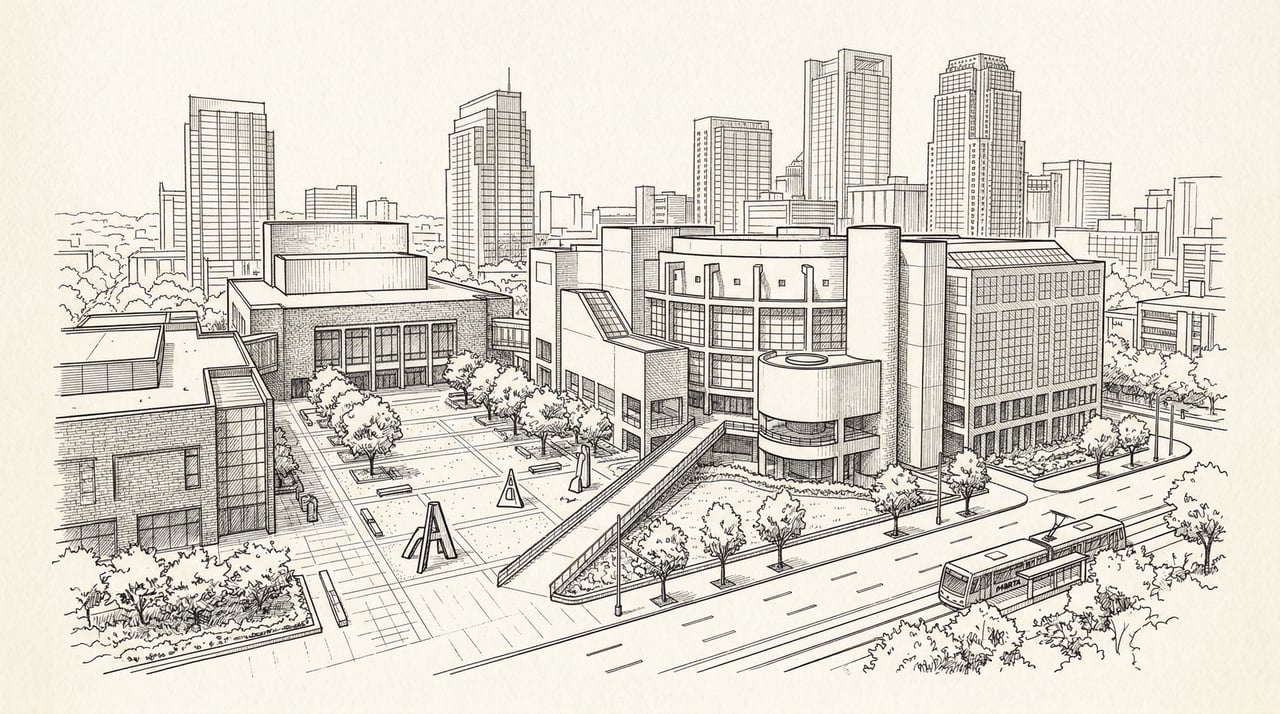
The Arts District stretches along Peachtree Street NE between 14th and 16th streets, placing residents within immediate reach of Atlanta's most concentrated collection of performing arts venues, fine museums, and cultural institutions.
The residential streets flanking Peachtree in this corridor, including stretches of West Peachtree Street NW and the quieter blocks running west toward Ansley Park, offer a calm counterpoint to the cultural energy just steps away.
High-rise condominiums and established mid-rise buildings along Peachtree provide elevated views of the Midtown skyline and the tree canopy below, while townhomes and smaller residential buildings on adjacent side streets offer a more intimate scale of living.
The area rewards those who value proximity not just to great art but to a particular texture of urban life — polished, intellectually alive, and grounded in the civic pride that the Woodruff campus has represented for more than five decades.
Living near the Woodruff Arts Center means that performances by the Atlanta Symphony Orchestra and productions at the Alliance Theatre are a short walk rather than a planned excursion.
The High Museum of Art, with its landmark Richard Meier building and Renzo Piano expansion, anchors the neighborhood's identity as a destination for those who take art and design seriously as part of daily life.
The pace on the residential side streets is noticeably slower than on Peachtree itself, with mature canopy trees, well-maintained sidewalks, and a sense that the neighborhood has earned its character honestly over many decades.
Weekend afternoons here often involve a walk through the museum, a long lunch at one of the nearby restaurants, and an evening performance, a lifestyle loop that requires almost no car and a great deal of appreciation for what a city can offer.
The Woodruff Arts Center was founded in 1968 in memory of 106 Atlanta arts patrons who perished in the 1962 Orly air disaster, a tragedy that galvanized the city's cultural leadership into building a permanent institution of lasting significance.
The campus grew steadily through the late twentieth century, attracting the High Museum of Art, which moved to its current Peachtree Street location in 1983 in a Richard Meier building that brought international architectural attention to Midtown Atlanta for the first time.
The surrounding residential blocks developed as Midtown matured through the mid-twentieth century, drawing Atlantans who wanted to live close to the civic and cultural life concentrated along the Peachtree Street corridor.
A Renzo Piano expansion of the High Museum in 2005 tripled the institution's gallery space and further elevated the area's international profile, reinforcing a neighborhood identity built equally on architectural ambition and cultural permanence.
A Trader Joe’s on the edge of Ansley Park provides a well-stocked, approachable option for daily provisions, while specialty grocers and the broader Ponce City Market hall are a short drive away for more curated and specialty selections.
The boutiques and design-forward shops along Peachtree Street NE and the side streets running toward Ansley draw residents for retail that favors quality and craft over volume, reflecting the considered aesthetic of this particular part of Midtown.
Pure Barre and several boutique fitness studios in the immediate area keep residents active close to home, while Ansley Park’s walking paths and the nearby Beltline trail system offer ample outdoor movement for every preference and schedule.
What is the overall feel of Arts District / Woodruff Arts Center Area?
This part of Midtown carries a sense of civic pride and cultural seriousness that distinguishes it from other Atlanta neighborhoods, drawing residents who want their daily surroundings to reflect a genuine engagement with art, architecture, and urban life. The Peachtree corridor here has a settled, purposeful quality that rewards those who choose a neighborhood with real intention.
What home styles are most common here?
High-rise condominiums along Peachtree Street define much of the residential landscape, offering floor-to-ceiling windows and Midtown skyline views — the quieter blocks toward Ansley Park introduce pre-war apartments and smaller residential buildings with a more intimate, human-scaled character for those who prefer a calmer street presence.
What makes Arts District / Woodruff Arts Center Area appealing for lifestyle buyers?
Few neighborhoods in Atlanta offer this degree of cultural proximity, placing the symphony, major theater, and one of the Southeast’s finest art museums within a brief walk of the front door. For buyers who measure a home’s quality partly by what surrounds it, this corridor is genuinely difficult to match in the city.
What does a typical day look like in Arts District / Woodruff Arts Center Area?
A weekday morning might include coffee on Peachtree before a walk through the High Museum’s permanent collection, followed by an afternoon of work and an evening performance at the Alliance Theatre just steps away. The rhythm here is refined, unhurried, and consistently rewarding for those who chose this neighborhood deliberately.
Is Arts District / Woodruff Arts Center Area a strong long-term ownership or investment choice?
The Woodruff Arts Center campus and High Museum anchor this corridor in a way that few cultural institutions anchor any neighborhood, providing an enduring civic draw that sustains long-term ownership value across market cycles. Residences close to this kind of irreplaceable infrastructure have consistently held appeal for generations of Atlanta buyers who understand what permanence looks like.