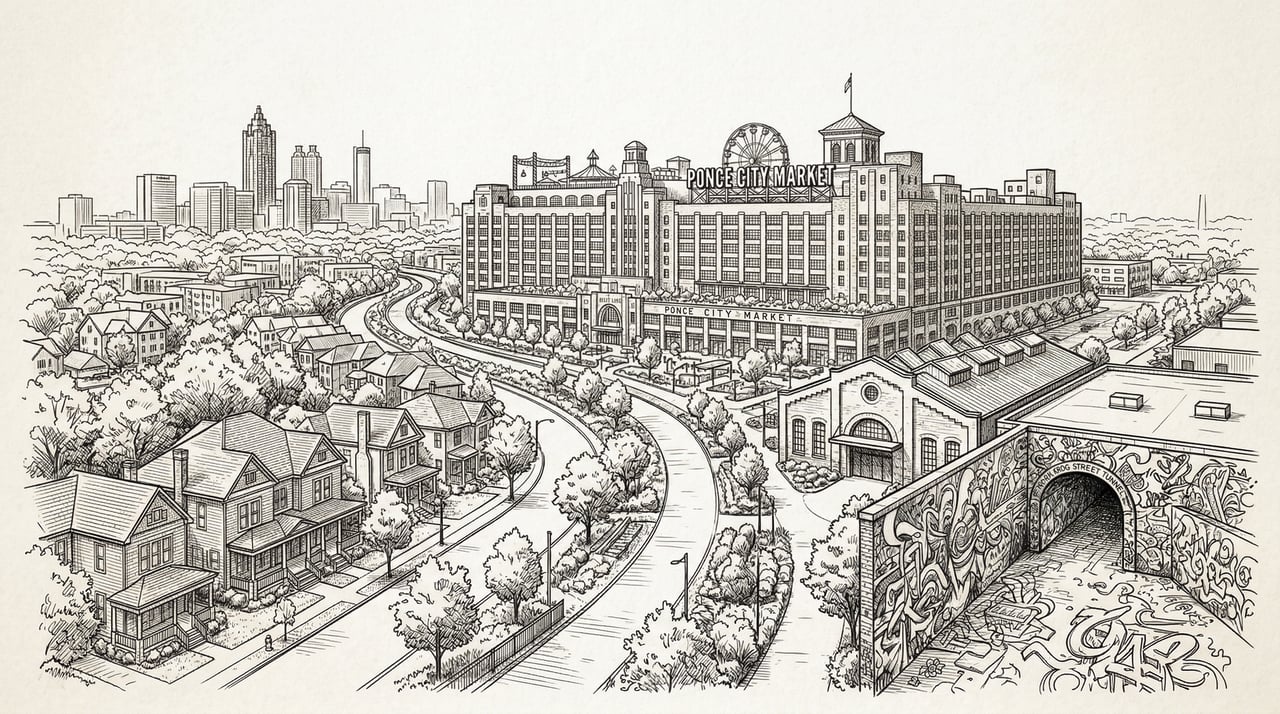
The Eastside of Atlanta collects some of the city’s most storied neighborhoods under one broad designation, from the canopied streets of Virginia-Highland to the historic corridors of Inman Park and Grant Park.
It is a part of Atlanta where the architecture tells a story and streets are built for walking, with Victorian facades, deep front porches, and overarching oak canopies defining the residential experience block by block.
Residents here often cite the Atlanta BeltLine trail as central to their decision to put down roots on the Eastside, with the trail threading through green space and past murals, markets, and gathering places that define the texture of daily life.
The Eastside’s character is grounded in preservation and civic pride. Many blocks retain their original Victorian-era streetscapes, giving the area a sense of permanence that draws long-term residents and sustains a genuine neighborhood identity across generations.
Life on Atlanta’s Eastside moves at a pace shaped by the neighborhood itself. Mornings often begin with a walk along a shaded residential street before settling into a locally owned coffee shop on Euclid Avenue or Highland Avenue.
The BeltLine Eastside Trail functions as the neighborhood’s connective spine, drawing cyclists, joggers, and strollers past public art installations, small parks, and the kind of passing street life that reminds residents why they chose this part of the city.
Krog Street Market anchors a food and gathering culture that is distinctly Eastside in character independent, craft-focused, and built around regulars who know the vendors and return often, making a Saturday morning errand into a two-hour social occasion.
Community events, neighborhood festivals, and front-porch culture reinforce the Eastside’s identity as a place where people know their neighbors and take genuine, long-held pride in the blocks they call home.
The Eastside neighborhoods developed in the late nineteenth and early twentieth centuries as Atlanta’s population expanded east of the downtown commercial core along Ponce de Leon Avenue and the old streetcar corridors.
Inman Park, platted in 1889 by developer Joel Hurt as Atlanta’s first planned suburb, set an architectural standard that influenced subsequent development throughout the Eastside, with large Victorian homes on generous lots lining tree-shaded streets.
Grant Park, one of Atlanta’s oldest residential communities, grew up around the park of the same name in the 1880s and 1890s, with a dense neighborhood of Craftsman bungalows and Queen Anne cottages taking shape close to the city’s heart.
Resident-led preservation movements beginning in the late 1960s and continuing through the 1980s restored much of the area’s architectural fabric, establishing the Eastside as a model of urban revitalization anchored in historic character and community-driven investment.
The Eastside supports a robust daily provisioning culture, with Sevananda Natural Foods Co-op on McLendon Avenue offering organic grocery staples and local goods in a neighborhood-owned setting that has served the community for decades with consistency and care.
Ponce City Market adds a curated retail dimension to the daily routine, with specialty shops, a food hall, and a rooftop offering that draws Eastside residents for both everyday errands and longer weekend excursions without leaving the neighborhood corridor.
Boutique fitness studios, local yoga spaces, and independent wellness providers are woven into the Eastside’s commercial streets, with the BeltLine trail and Freedom Park serving as daily wellness resources for residents who build outdoor movement into their morning and evening routines as a matter of habit.
What is the overall feel of Atlanta’s Eastside?
The Eastside carries a relaxed, community-oriented character that reflects decades of neighbor-led stewardship and genuine attachment to place. It is one of the few parts of Atlanta where a deep urban energy and a quiet residential character coexist naturally on the same block, making it feel unlike any other part of the city.
What home styles are most common here?
Victorian-era Queen Anne cottages, Craftsman bungalows, and Colonial Revival homes define the Eastside’s architectural identity, many of them meticulously restored over the past several decades. New infill construction and contemporary condominiums are also present near BeltLine-adjacent corridors, offering buyers a range of entry points into a historically grounded area.
What makes Atlanta’s Eastside appealing for lifestyle buyers?
The combination of walkable streets, outstanding independent dining, BeltLine trail access, and a deeply rooted neighborhood culture is unusual to find in a single connected area. Buyers who value architectural character, a strong sense of place, and a community of long-term owners consistently gravitate toward the Eastside as their preferred part of Atlanta.
What does a typical day look like on the Eastside?
A morning on the Eastside might begin with coffee from a neighborhood cafe and a walk along the BeltLine before the day’s work begins. Evenings often bring residents back outside for dinner on Highland Avenue, a stop at Krog Street Market, or a quiet stroll through the tree-lined streets nearest to home.
Is the Eastside a strong long-term ownership or investment choice?
The Eastside’s combination of historic architecture, walkable infrastructure, and BeltLine connectivity has made it one of Atlanta’s most consistently sought-after residential areas over the past two decades. Long-term owners who invest in the area’s preservation tend to stay, which creates the stability and community density that sustains a neighborhood’s character and appeal over time.