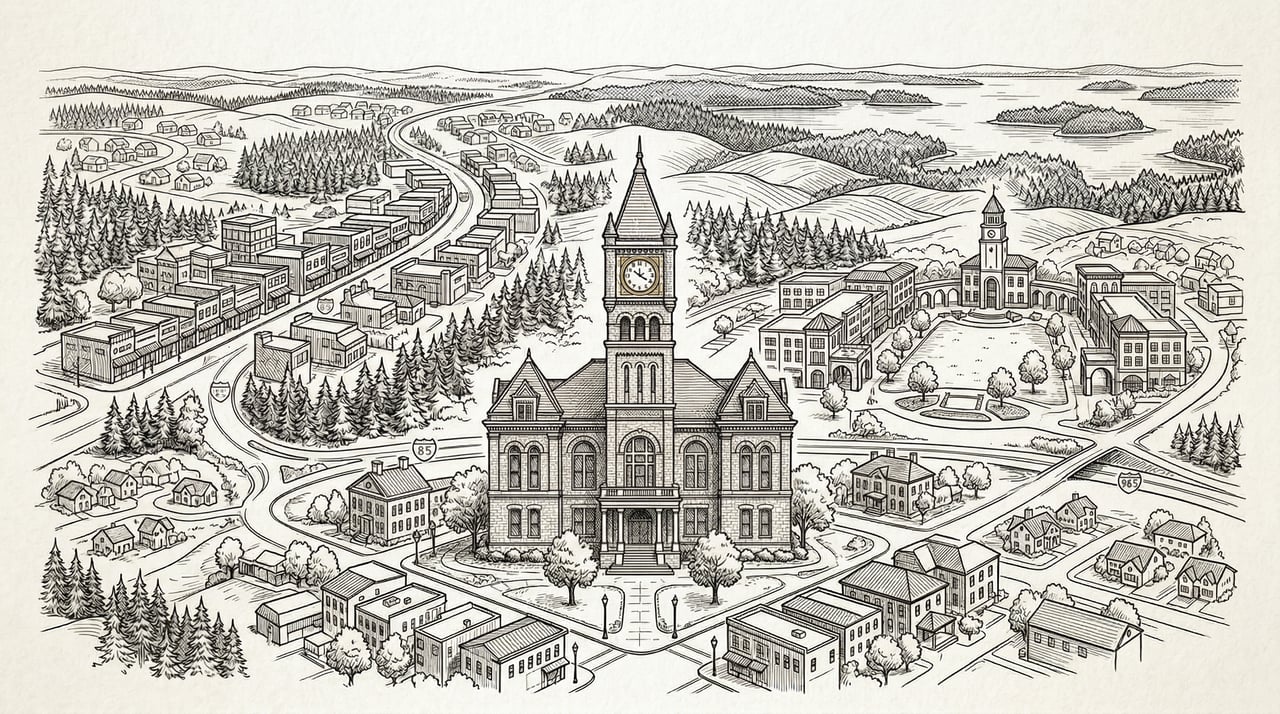
Gwinnett County stretches northeast from the I-285 perimeter into a landscape of established subdivisions, lakeside communities, and master-planned neighborhoods that have made it one of Georgia's most populous and consistently sought-after residential counties.
The county's residential range extends from older ranch-home neighborhoods near Norcross and Lilburn to the newer planned communities of Suwanee, Sugar Hill, and Dacula, each with its own commercial village and a distinct neighborhood identity shaped by years of settled community life.
Peachtree Industrial Boulevard and Sugarloaf Parkway serve as the county's primary commercial spines, connecting residents to regional retail, employment centers, and the internationally celebrated dining corridor that defines Gwinnett's culinary identity beyond the boundaries of the Atlanta metro.
Communities like Peachtree Corners and Suwanee have developed walkable town centers that give their neighborhoods a genuine focal point, reducing car-dependency and encouraging a more connected daily rhythm built around shared outdoor space and local commerce.
Gwinnett County's outdoor amenities trace the creekways and greenways winding through its residential fabric, from the Suwanee Creek Greenway in the north to the Yellow River corridor near Lilburn and Lawrenceville's eastern neighborhoods.
The county's dining landscape has earned national recognition, with a concentration of Vietnamese, Korean, Chinese, and Latin American restaurants along the Buford Highway corridor and Pleasant Hill Road that draws enthusiastic visitors from across the MSA every weekend.
Town green programming and community markets in Suwanee and Peachtree Corners anchor shared gathering patterns, while the county's network of aquatic centers and athletic facilities support an actively family-oriented culture at nearly every residential address.
On fall evenings, the walking paths around Suwanee Town Center and the pedestrian areas of Peachtree Corners draw residents into a shared outdoor rhythm that feels curated and community-oriented in a way that belies the county's considerable scale.
Gwinnett County was formed in 1818 as one of Georgia's original counties carved from Creek Nation territory and named for Button Gwinnett, a Georgia delegate who signed the Declaration of Independence and is remembered as one of the most elusive autographs in American philatelic history.
Through the 19th century, the county developed as an agricultural region, with Lawrenceville growing into its commercial and civic anchor along a grid of streets that still defines the historic downtown courthouse square in its current form.
Rapid postwar suburban growth transformed Gwinnett's cotton fields and pine forests into the residential subdivisions that now house more than one million residents, making it one of the most populous counties in the southeastern United States by any measure.
The county's architectural character reflects this layered growth history, with ranch and split-level homes from the 1960s and 70s filling older neighborhoods near Norcross, while newer communities in Suwanee and Sugar Hill favor craftsman and farmhouse-inspired designs on wooded cul-de-sac lots.
Buford Highway Farmers Market near Doraville and Whole Foods Market locations in Duluth and Suwanee give Gwinnett County residents access to both premium national grocery options and the extraordinary international specialty grocery culture that defines the county's culinary character.
The Forum on Peachtree Pkwy and Suwanee Town Center offer walkable concentrations of independent boutiques, home goods retailers, and specialty shops that give northern Gwinnett a retail experience more curated than its suburban scale might suggest.
Pure Barre and Orangetheory Fitness studios in Duluth, Suwanee, and Peachtree Corners give residents structured fitness options within a short distance of most residential addresses, supplemented by a growing network of locally owned yoga and wellness studios throughout the county.
What is the overall feel of Gwinnett County?
Gwinnett County is defined by a democratic energy — a place where master-planned communities, international cultural influences, and well-developed suburban amenity coexist without friction across a landscape that is larger and more varied than most first-time visitors expect. The county's scale gives it more neighborhood variety than any single resident is likely to fully explore, with each community carrying a distinct character shaped by its particular history and residential composition.
What home styles are most common here?
Ranch and traditional split-level homes fill the older neighborhoods near Norcross, Lilburn, and the Doraville border, while newer master-planned communities in Suwanee, Sugar Hill, and Dacula favor craftsman and transitional designs with open-concept interiors on wooded lots. The county's broad housing stock means that buyers at many different preferences and price points can find a home that fits both their aesthetic and their daily practical requirements.
What makes Gwinnett County appealing for lifestyle buyers?
Gwinnett County's appeal lies in the combination of community infrastructure, outdoor access, and one of the most internationally diverse dining scenes in the southeastern United States, giving residents a level of daily cultural variety that few suburban counties in any major metro can match. Buyers who value both neighborhood stability and genuine cultural richness tend to find Gwinnett a deeply satisfying and surprisingly layered long-term address.
What does a typical day look like in Gwinnett County?
A Gwinnett morning might begin with a run along the Suwanee Creek Greenway before shifting to a midday lunch at one of the county's standout Asian or Latin American restaurants, where the quality and variety of the meal would be unremarkable in Hong Kong or Seoul but remains a genuine point of local pride. Evenings find residents at town center gathering spots, local restaurants, or the Infinite Energy Center in Duluth for concerts, sporting events, or arena programming.
Is Gwinnett County a strong long-term ownership or investment choice?
Gwinnett County's sustained population growth, diversified employer base, and continued infrastructure investment have supported strong long-term residential demand across its neighborhoods and price tiers for several decades running. The county's position as the MSA's most populous suburban jurisdiction gives ownership here a stability grounded in demonstrated, broad-based residential interest that has proven durable through varied economic conditions.