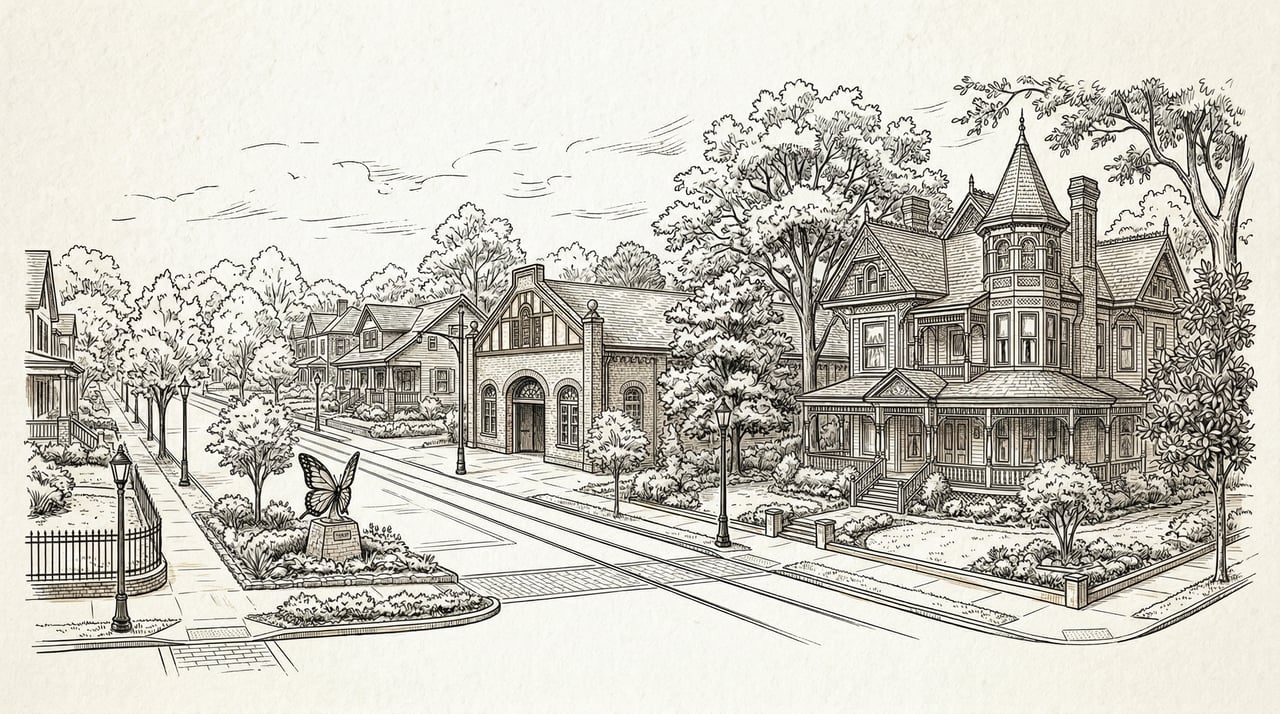
Inman Park holds the distinction of being Atlanta’s first planned suburb, developed in 1889 by Joel Hurt along a new streetcar line east of downtown with the deliberate intention of creating a gracious residential community defined by beauty, order, and proximity to the city.
The neighborhood’s original design centered on Springvale Park, a quiet central green flanked by grand Victorian homes, and that same park remains the physical and social heart of Inman Park more than a century later.
Euclid Avenue and Elizabeth Street are lined by impeccably maintained Queen Anne, Italianate, and Second Empire homes that represent the full architectural ambition of late-nineteenth-century residential design in the South, most of them brought back to their original character through decades of careful private stewardship.
Krog Street Market brings a contemporary gathering energy to the neighborhood’s eastern edge, drawing residents and visitors alike to a curated collection of independent restaurants, a wine bar, and specialty food vendors that has made this part of Inman Park one of Atlanta’s most reliably lively destinations.
Inman Park rewards residents who appreciate the pleasures of a walkable neighborhood at full maturity. Euclid Avenue and Highland Avenue offer a reliable rotation of restaurants, cafes, and local shops within easy reach of nearly every home in the neighborhood.
The BeltLine Eastside Trail runs along Inman Park’s southern boundary, giving residents direct access to a linear greenway that connects the neighborhood to Ponce City Market, Old Fourth Ward, Grant Park, and the broader Eastside trail network by foot or bicycle.
Freedom Park stretches along the neighborhood’s northern edge, providing a wide greenway corridor with a paved trail and open lawns that draw residents for morning runs, weekend walks, and the quiet pleasure of an outdoor space that feels like a natural extension of the residential blocks surrounding it.
The Inman Park Festival, one of Atlanta’s oldest neighborhood events, reflects the community’s deep civic investment and long tradition of gathering around shared public space in a way that sustains neighborhood identity from one generation to the next.
Joel Hurt developed Inman Park in 1889 as Atlanta’s first streetcar suburb, designing the community along the new Edgewood Avenue electric streetcar line with curving streets, generous lot sizes, and a central park intended to offer residents an alternative to the density of downtown living.
The neighborhood took its name from Samuel Inman, a prominent Atlanta cotton merchant and civic figure of the late nineteenth century, and attracted many of Atlanta’s leading families to its grand Victorian homes during its first decades of development.
By the mid-twentieth century, Inman Park had declined significantly as suburban growth drew residents outward, but a pioneering community of buyers beginning in the late 1960s recognized the neighborhood’s architectural quality and began a systematic restoration that would transform it into one of Atlanta’s most celebrated historic districts.
The founding of the Inman Park Restoration Association in 1969 is widely credited as one of the first successful urban neighborhood restoration efforts in the American South, establishing a model of community-led preservation followed by neighborhoods across Atlanta and beyond in subsequent decades.
Inman Park’s daily provisioning scene is anchored by Sevananda Natural Foods Co-op on McLendon Avenue, a neighborhood-owned cooperative grocery that has served the community for decades with organic staples, locally sourced produce, and a selection that reflects the Eastside’s commitment to quality and independent commerce.
Krog Street Market adds a curated retail and provisions dimension to the daily routine, with specialty vendors and local purveyors that give residents a walkable alternative to larger commercial districts for both everyday needs and the kind of weekend browsing that rewards a slow morning.
Boutique fitness studios and yoga spaces have established a strong presence along Edgewood Avenue and the surrounding streets, and the BeltLine and Freedom Park trails serve as daily movement resources that many Inman Park residents integrate into their mornings and evenings as a natural extension of the neighborhood’s outdoor character.
What is the overall feel of Inman Park?
Inman Park has a rare combination of architectural grandeur and genuine neighborhood warmth, the kind of place where residents invest deeply in their homes, know their neighbors, and participate in the civic life of their community over the long term. It carries a sense of earned pride rooted in the decades of restoration work that brought it back to its full original character.
What home styles are most common here?
Queen Anne, Italianate, and Second Empire Victorian homes dominate the streets closest to Springvale Park and Euclid Avenue, representing some of the finest preserved examples of late-nineteenth-century residential architecture in Atlanta. Craftsman bungalows and early-twentieth-century foursquares fill out the surrounding streets, giving buyers several architectural registers to choose from within a single neighborhood.
What makes Inman Park appealing for lifestyle buyers?
The combination of walkable dining and retail, immediate BeltLine access, and a richly defined neighborhood character cultivated over decades makes Inman Park difficult to match elsewhere in Atlanta. Buyers who want to live in a place with a strong identity, a connected outdoor lifestyle, and a community that actively invests in its own future find Inman Park consistently meets that standard.
What does a typical day look like in Inman Park?
A morning in Inman Park might begin with a coffee on the front porch, followed by a run through Freedom Park or a ride along the BeltLine. Evenings offer a short walk to dinner on Highland Avenue or a stop at Krog Street Market, with the neighborhood’s walkability making the car an afterthought rather than a necessity for most daily routines.
Is Inman Park a strong long-term ownership or investment choice?
Inman Park’s status as Atlanta’s first planned suburb and a National Register historic district, combined with its BeltLine connectivity and acclaimed dining scene, has established it as one of the region’s most enduringly desirable residential addresses. Owners who restore and hold here benefit from a community that reinforces its own appeal through active preservation, civic engagement, and a culture of long-term investment in the neighborhood’s built environment.
5,282 people live in Inman Park, where the median age is 32 and the average individual income is $105,144. Data provided by the U.S. Census Bureau.
Total Population
Median Age
Population Density Population Density This is the number of people per square mile in a neighborhood.
Average individual Income
There's plenty to do around Inman Park, including shopping, dining, nightlife, parks, and more. Data provided by Walk Score and Yelp.
Explore popular things to do in the area, including Bridge Boutique, Mint By Sandpiper, and Emily Cuts Hair.
| Name | Category | Distance | Reviews |
Ratings by
Yelp
|
|---|---|---|---|---|
| Shopping | 0.19 miles | 0 reviews | 0/5 stars | |
| Shopping | 0.2 miles | 0 reviews | 0/5 stars | |
| Beauty | 0.23 miles | 0 reviews | 0/5 stars | |
| Beauty | 0.53 miles | 0 reviews | 0/5 stars | |
| Beauty | 0.76 miles | 0 reviews | 0/5 stars | |
|
|
||||
|
|
||||
|
|
||||
|
|
||||
|
|
||||
|
|
Inman Park has 2,868 households, with an average household size of 2. Data provided by the U.S. Census Bureau. Here’s what the people living in Inman Park do for work — and how long it takes them to get there. Data provided by the U.S. Census Bureau. 5,282 people call Inman Park home. The population density is 12,900 and the largest age group is Data provided by the U.S. Census Bureau.
Total Population
Population Density Population Density This is the number of people per square mile in a neighborhood.
Median Age
Men vs Women
Population by Age Group
0-9 Years
10-17 Years
18-24 Years
25-64 Years
65-74 Years
75+ Years
Education Level
Total Households
Average Household Size
Average individual Income
Households with Children
With Children:
Without Children:
Marital Status
Blue vs White Collar Workers
Blue Collar:
White Collar: