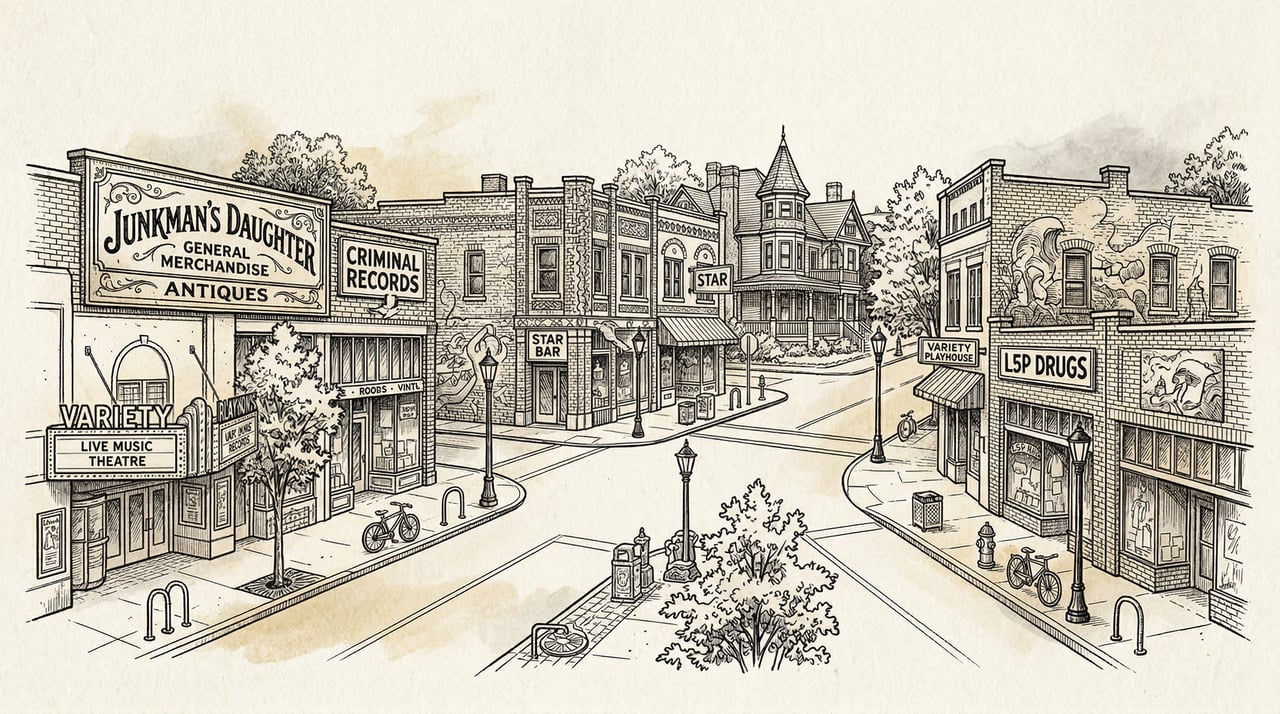
Little Five Points sits along the eastern fringe of the Atlanta BeltLine corridor, where North Highland Avenue meets Moreland Avenue in a neighborhood that has long drawn residents who value creative community over convenience.
The streets feel genuinely lived-in, with Victorian-era cottages and local art installations creating an intimacy that is rarely found in Atlanta neighborhoods of similar size and walkability.
Saturday mornings bring a steady rhythm along Euclid Avenue, with residents stopping for coffee at local shops before browsing the independent storefronts that line the corridor from Seminole Avenue through Colquitt Avenue.
The tree canopy over the side streets off Moreland holds the quiet on weekday mornings, and many homes here sit on lots that feel removed from the city’s pace despite being just minutes from its center.
Variety Playhouse on Euclid Avenue has anchored the neighborhood’s live music identity for decades, drawing intimate shows year-round that keep residents connected to Atlanta’s broader arts community.
Independent shops like Criminal Records have defined the Euclid Avenue corridor for years, offering the kind of curated browsing experience that chain retail cannot replicate for those who live close enough to visit on foot.
Evenings here tend to start with a walk and end with dinner on a covered patio facing the street, a rhythm that reflects the neighborhood’s deeply pedestrian character and its preference for the local and unhurried.
The proximity to the Freedom Parkway trail and the BeltLine’s Eastside Trail gives residents access to miles of connected green space within easy walking distance, anchoring the morning routines of those who make their home here.
The commercial district around the intersection of Euclid and Moreland avenues developed in the early twentieth century as a neighborhood anchor for the surrounding residential blocks of Inman Park and Candler Park.
The district earned its name from the five-way intersection at its core, and the brick storefronts lining those original corridors still carry the ground-floor retail character of that founding period of Atlanta’s growth.
During the 1970s and 1980s, the area became a gathering point for Atlanta’s independent arts and music community, which invested in the existing building stock and helped establish the identity the neighborhood carries today.
That commitment to preservation has carried forward, and much of the built environment along Moreland and Euclid reflects continuous stewardship rather than wholesale redevelopment across multiple real estate cycles.
Sevananda Natural Foods on McLendon Avenue has served the neighborhood as a community-owned cooperative grocery for decades, offering organic produce, bulk goods, and a commitment to local sourcing that residents rely on as part of their weekly routine.
Independent boutiques and vintage shops along Euclid and Moreland provide a retail experience rooted in personal curation, with longtime shops like Junkman’s Daughter drawing loyal regulars who value local ownership over the predictability of chain stores.
Fitness options in the neighborhood lean toward the independent and the intimate, with yoga studios and small-format training spaces along Euclid and North Highland offering attentive, small-class instruction that larger gyms rarely provide.
What is the overall feel of Little Five Points?
Little Five Points carries the energy of a neighborhood with clear convictions about what it wants to be. The streets feel genuinely independent, and a creative street life rewards residents who want community to be something lived daily rather than merely described in a listing.
What home styles are most common here?
The residential blocks around the commercial core are anchored by late Victorian and Craftsman bungalows built in the early twentieth century, many of which retain original woodwork and front-porch setbacks that give the streets their distinctive, unhurried character. Newer infill development has been modest in scale, preserving the neighborhood’s low-rise profile and walkable residential fabric.
What makes Little Five Points appealing for lifestyle buyers?
Little Five Points attracts buyers who place a high value on walkability, local ownership, and a neighborhood that holds its identity across decades rather than following development trends toward uniformity. The access to parks, trails, and a deeply rooted commercial corridor makes it a compelling choice for those seeking urban life with genuine community depth and a clear sense of place.
What does a typical day look like in Little Five Points?
A weekday morning might begin with coffee from a neighborhood shop on Euclid, followed by a walk along the Freedom Parkway trail before the corridor comes fully to life by mid-morning. Evenings unfold slowly, with dinner at a neighborhood table on a patio facing the street and a walk home through blocks that feel genuinely personal.
Is Little Five Points a strong long-term ownership or investment choice?
Little Five Points has maintained its character and desirability through multiple cycles of Atlanta’s growth, which speaks to the durability of the neighborhood’s identity and the commitment of those who choose to invest here. The combination of architectural stock, walkability, and proximity to the BeltLine gives long-term owners a well-grounded foundation for continued value.