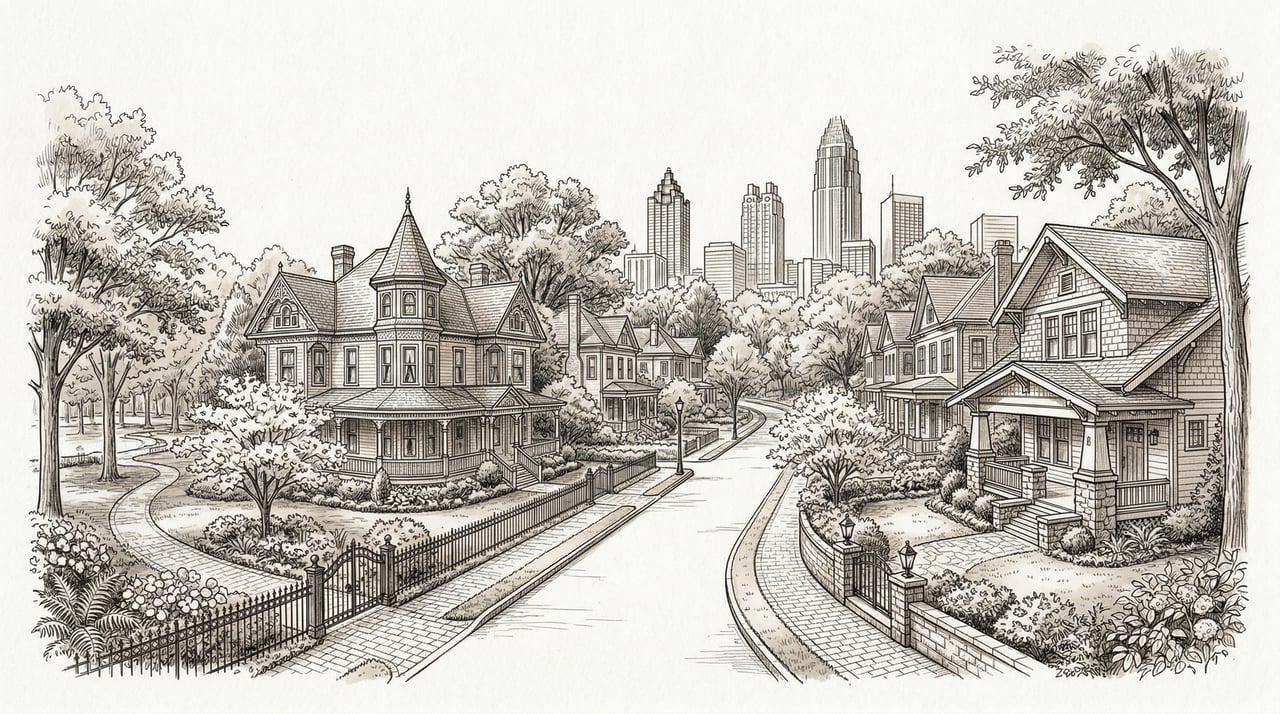
The Midtown Garden District occupies one of Atlanta's most gracious residential pockets, a neighborhood of tree-canopied streets and Victorian-influenced homes that sits in welcome contrast to the busier corridors of Peachtree Street just a few blocks to the west.
Streets here follow a quieter tempo—front porches set behind garden borders, flowering trees along the parkways, and the kind of architectural detail that rewards a slow walk through the neighborhood's residential avenues in the morning light.
Residents benefit from proximity to all that Midtown offers while living in a neighborhood that has preserved the human scale and garden character that gives this district its distinctive identity. The flowering magnolias and dogwoods that transform Charles Allen Drive and the neighboring blocks each spring are among the most beautiful passages in any Atlanta neighborhood, and they return year after year with the reliability of a well-tended place.
Life in the Midtown Garden District is shaped by the best of two overlapping worlds—the cultural and culinary richness of Midtown Atlanta on one side, and the residential calm of a genuine neighborhood where people know their neighbors on the other.
Mornings often begin with a walk to a nearby cafe or a loop through Piedmont Park along the Monroe Drive entrance, and afternoons find residents in a neighborhood where independent bookshops, art galleries, and specialty shops share blocks with well-maintained Victorian cottages and landscaped front gardens.
The pace of weekend life here tends toward the contemplative—a long morning at the Saturday Green Market at Piedmont Park, followed by a leisurely afternoon in a garden that takes full advantage of Atlanta's generous growing season and the neighborhood's tradition of careful, considered horticulture that gives the Garden District its name and its most enduring quality.
History of Midtown Garden District
The Midtown Garden District developed primarily in the late nineteenth and early twentieth centuries, when Atlanta's expanding professional class built comfortable, architecturally considered homes along the neighborhood's principal streets with an emphasis on front gardens and the gracious presentation of domestic life.
The area's Victorian and Craftsman-influenced homes reflect the domestic architectural ideals of their era—generous porches, ornamental woodwork, and landscaped front gardens that signaled both civic pride and personal investment in the quality of the neighborhood's shared streetscape.
A period of preservation effort beginning in the 1970s and 1980s helped the neighborhood resist the pressures of commercial development and highway expansion that reshaped nearby parts of Midtown, leaving the Garden District with an architectural coherence that has become increasingly rare in Atlanta's inner neighborhoods. That preservation, sustained by generations of committed residents, is the foundation of everything the district offers buyers who arrive here seeking something that cannot be built from scratch.
Whole Foods Market on Ponce de Leon anchors the neighborhood's daily provisions, while independently owned cafes along Crescent Avenue and North Highland Avenue—including Aurora Coffee—provide the morning rituals that give Garden District life its particular unhurried character and neighborhood feeling.
The boutiques and design shops along Virginia Avenue and the Beltline retail corridor offer residents a considered shopping experience distinct from the chain retail of busier corridors, with independently owned clothing, home goods, and specialty shops whose curated selections reflect the aesthetic sensibility that the neighborhood has cultivated across generations of resident investment.
Wellness in the Garden District draws from a constellation of boutique studios within walking distance along 10th Street and Monroe Drive—including dedicated Pilates, barre, and yoga practices whose regular clients live within a few blocks of the studio door and whose presence in the neighborhood is itself a sign of the quality and walkability of daily life here.
>
What is the overall feel of Midtown Garden District?
The Midtown Garden District feels like a neighborhood that has consciously preserved its identity—residential, garden-influenced, and architecturally coherent in a way that sets it apart from Midtown's more commercially active corridors. It is quiet without being remote, and it offers the rare combination of genuine neighborhood character alongside the full cultural and culinary offering of one of Atlanta's most vibrant districts.
What home styles are most common here?
Housing here skews toward Victorian-era single-family homes, Craftsman bungalows, and early twentieth-century cottages, many of which have been carefully restored and updated while retaining their original architectural character, detailed woodwork, and the generous front garden settings that give the neighborhood its name and its most distinctive visual quality.
What makes Midtown Garden District appealing for lifestyle buyers?
The neighborhood appeals to buyers who want the full cultural offering of Midtown—the arts, the dining, the walkability—but who also value a residential streetscape with real depth and the kind of neighbor relationships that develop only in genuinely livable places. The Garden District offers urban access without sacrificing the qualities that make a neighborhood feel like a home rather than a location.
What does a typical day look like in Midtown Garden District?
A typical day in the Midtown Garden District begins with coffee on a front porch or a walk to one of the neighborhood's independent cafes, followed by a morning at home or in Midtown's cultural institutions a short walk away. Evenings find residents at a neighborhood restaurant or a gallery opening nearby, returning at day's end to a street that is quiet, beautiful, and entirely theirs.
Is Midtown Garden District a strong long-term ownership or investment choice?
Homes in the Midtown Garden District have shown strong long-term ownership appeal supported by the neighborhood's architectural integrity, the constrained supply of period homes on landscaped lots, and a location within one of Atlanta's most enduringly desirable residential areas. Buyers who move here tend to stay, and the neighborhood's consistent demand from informed buyers reflects the depth and authenticity of what it offers.