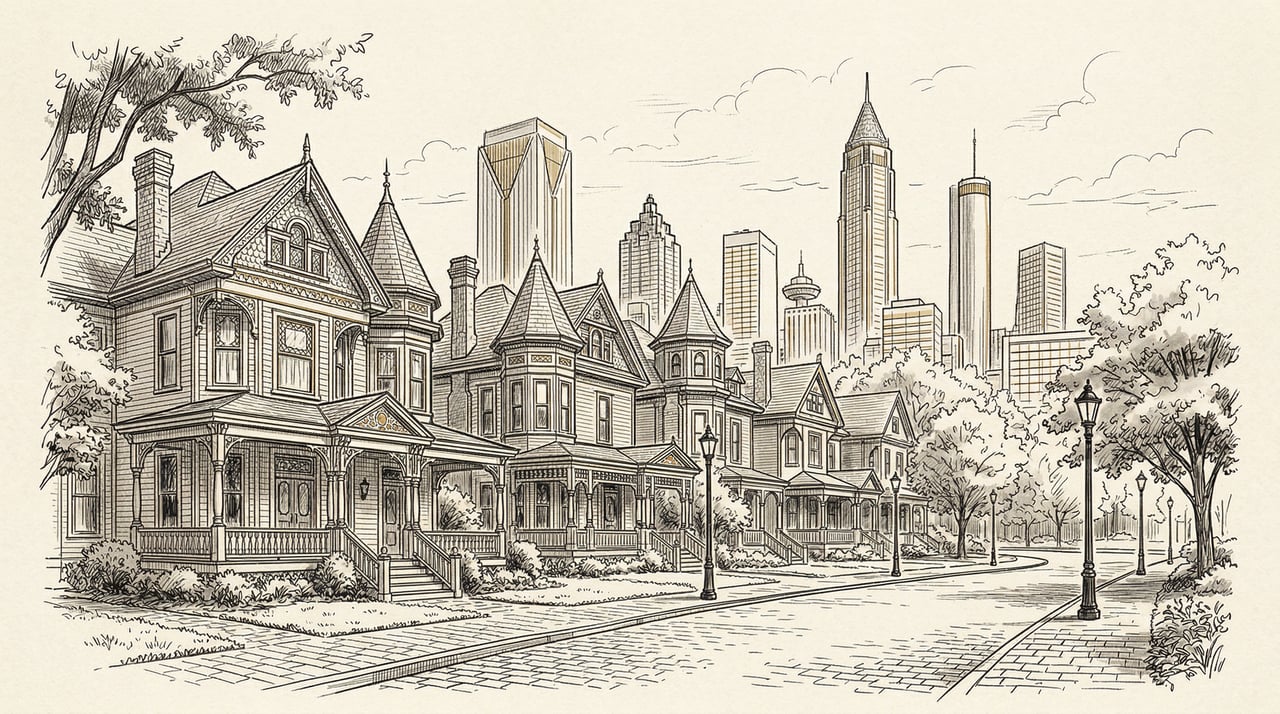
The Midtown Historic District is the architectural heart of Atlanta’s most densely layered urban neighborhood, a place where preserved Victorian and Beaux-Arts buildings stand alongside mid-century storefronts and carefully considered modern infill.
Residents live amid a concentration of cultural institutions, including the Fox Theatre, the High Museum of Art, and the Woodruff Arts Center, that few addresses anywhere in the South can match.
The district’s blocks are defined by their human scale, with canopied streets, ornate cornices, and residential buildings that carry the memory of Atlanta’s early twentieth-century ambitions in every carefully preserved facade.
Living here means committing to an urban life at full intensity, with restaurants, galleries, and professional destinations accessible on foot and the city’s skyline visible from most upper-floor terraces and shared rooftop spaces above.
Life in the Midtown Historic District centers on cultural access, with the Fox Theatre, the Alliance Theatre, the Atlanta Symphony Orchestra, and the High Museum all within walking distance of most front doors.
The district’s proximity to Piedmont Park means that weekend mornings can begin with a loop through the park’s green expanse before returning to a cafe along Peachtree Street for a long, unhurried brunch.
Residents tend to be highly engaged with the city’s creative and professional life, drawn here by the particular energy of a neighborhood where historic preservation and forward-looking urban culture share the same address.
The Atlanta BeltLine Eastside Trail, accessible from the district’s southern boundary, adds a recreational layer connecting residents to a landscaped linear park lined with restaurants, galleries, and public art installations.
Midtown Atlanta’s historic district developed from the late nineteenth century onward along Peachtree Street, the city’s defining commercial and residential artery, as Atlanta rebuilt itself into a regional capital following the Civil War era.
The neighborhood’s architectural character took form in the 1890s and early 1900s, when Atlanta’s commercial prosperity brought Victorian and Beaux-Arts styles to Peachtree Street in the form of ornate commercial facades and ambitious civic buildings.
The Fox Theatre, opened in 1929 and now one of the most celebrated performing arts venues in the United States, stands as the district’s most iconic landmark and a testament to that era’s confidence in civic grandeur.
Preservation efforts beginning in the 1970s protected many of the district’s most significant buildings from demolition, allowing Midtown’s historic core to evolve as a living neighborhood rather than a purely commercial or institutional district.
Grocery needs are anchored by the Whole Foods Market on Ponce de Leon Avenue and a well-stocked Publix nearby, while Joe the Art of Coffee on Peachtree Street serves the neighborhood’s morning crowd with carefully prepared craft espresso.
The Peachtree Street corridor supports a refined collection of boutiques and concept stores, with the Shops at Buckhead Atlanta accessible minutes to the north for luxury retail and internationally recognized labels alongside curated independent retailers.
Wellness studios cluster throughout the district, including CorePower Yoga and Pure Barre locations within the surrounding blocks, each drawing a regular clientele of residents and professionals who value proximity and quality instruction.
What is the overall feel of Midtown Historic District?
The Midtown Historic District has the texture of a neighborhood that has been living at full cultural intensity for over a century. Preserved facades, walkable blocks, and proximity to theater, art, and dining create a daily environment that is genuinely difficult to replicate anywhere else in Atlanta.
What home styles are most common here?
The district’s housing spans Victorian single-family homes, early apartment buildings, and mid-century residential towers concentrated within blocks the city has actively worked to protect. Newer condominiums fill the gaps between them, maintaining a layered architectural conversation that makes the district one of Atlanta’s most visually compelling residential addresses.
What makes Midtown Historic District appealing for lifestyle buyers?
Few urban addresses in the Southeast match the density of cultural experience available within walking distance here. The Fox Theatre, High Museum, Alliance Theatre, and Piedmont Park are all part of the daily backdrop, making this a choice driven by a genuine desire for engaged, immersive city living.
What does a typical day look like in Midtown Historic District?
A typical day here begins with an espresso at a Peachtree Street cafe before passing the Fox Theatre’s ornate facade on the way to a nearby office or studio. Evenings offer gallery openings, live performances, and a range of restaurant options that few other addresses in Atlanta can rival on any given night.
Is Midtown Historic District a strong long-term ownership or investment choice?
Midtown’s growth as a corporate and technology hub has sustained steady demand for residences in the district, and preservation protections have maintained the architectural quality that underpins long-term desirability. The central location, cultural richness, and limited supply of historic housing make ownership here a well-founded long-term position.