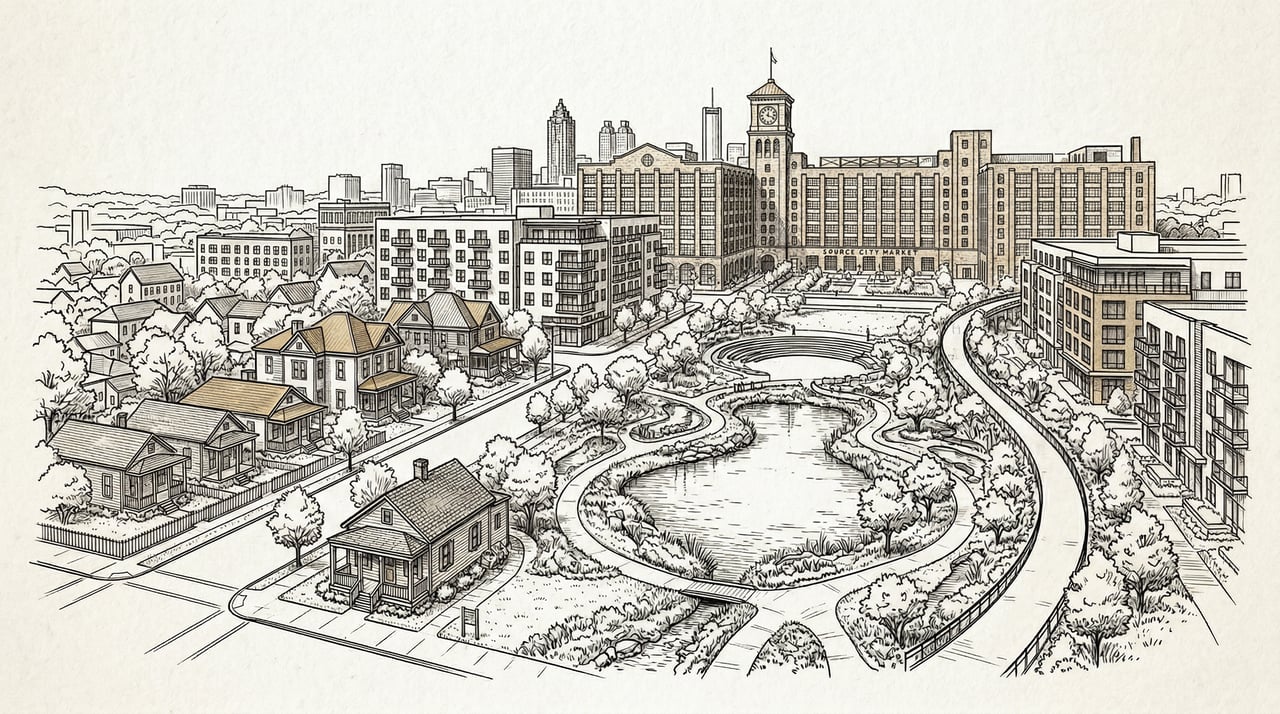
Old Fourth Ward occupies a historic stretch of Atlanta’s Eastside, where the BeltLine’s Eastside Trail has become the organizing spine of a neighborhood that has transformed remarkably while holding onto the bones of its original residential layout.
The street grid of Edgewood Avenue, Randolph Street, and North Avenue remains largely intact, with shotgun houses, Craftsman bungalows, and early twentieth-century cottages standing alongside thoughtfully designed newer construction throughout.
Ponce City Market, the restored 1920s Sears distribution building on Ponce de Leon Avenue, anchors the neighborhood’s northern edge and draws residents, diners, and visitors into its carefully curated collection of vendors and shops each day.
The green corridor connecting the BeltLine to Historic Fourth Ward Park gives the neighborhood an outdoor amenity that few Atlanta addresses can match for both daily accessibility and sheer natural beauty across the seasons.
Life in Old Fourth Ward is organized around the BeltLine trail, where morning runners, weekend cyclists, and afternoon walkers create the informal daily gathering that defines the neighborhood’s rhythm from sunrise through evening.
Krog Street Market adds an intimate food hall and outdoor market experience rooted in neighborhood scale, drawing a steady mix of residents and visitors to its collection of independent vendors throughout the week.
The range of loft conversions, restored row houses, and new townhomes along Irwin Street and Cain Street gives buyers multiple residential options within walking distance of the same parks, trails, and restaurant corridor.
Weekend brunch culture along Edgewood Avenue draws residents into the streets with genuine energy, creating the kind of outdoor seating and pedestrian momentum that belongs to a neighborhood rather than a curated destination.
The Fourth Ward takes its name from Atlanta’s original ward boundary designations, and the neighborhood’s street grid reflects the orderly residential development that shaped the area in the late nineteenth and early twentieth centuries.
Edgewood Avenue served as a primary commercial and civic corridor for the surrounding residential blocks, and many of the masonry storefronts along that street date to the neighborhood’s founding period of growth and civic investment.
The conversion of the former Sears distribution building on Ponce de Leon Avenue into Ponce City Market stands as one of Atlanta’s most consequential adaptive reuse achievements, returning a long-vacant landmark to daily life.
The opening of the BeltLine’s Eastside Trail along the former freight rail corridor catalyzed a sustained period of investment that has reinforced rather than erased the neighborhood’s historic residential and commercial character.
Ponce City Market’s ground-floor food hall and specialty market vendors serve as a primary daily stop for many residents, offering curated groceries, prepared foods, and coffee all within the landmark building that anchors the neighborhood’s northern edge.
Along Edgewood Avenue and Krog Street, locally owned boutiques and design shops reward deliberate exploration, with each storefront reflecting the curatorial sensibility of individual ownership rather than national brand directives from elsewhere.
Fitness studios and wellness spaces cluster along the BeltLine corridor and the cross streets feeding it, giving residents access to boutique cycling, yoga, and personal training options within a short walk of most addresses in the neighborhood.
What is the overall feel of Old Fourth Ward?
Old Fourth Ward moves at the pace of an established urban neighborhood that knows what it has. The BeltLine, the park system, and the concentration of well-regarded restaurants and shops create a daily environment that rewards those who want the city to be genuinely accessible from their front door.
What home styles are most common here?
The historic residential sections consist largely of late Victorian and early twentieth-century vernacular architecture, including shotgun houses, four-square homes, and Craftsman bungalows on relatively modest lots with strong street presence. Newer development has added loft conversions, townhomes, and midrise residential buildings that bring broader options for buyers at different price points.
What makes Old Fourth Ward appealing for lifestyle buyers?
Old Fourth Ward draws buyers who want walkable urban living without sacrificing access to genuine neighborhood character and meaningful green space within the city. The BeltLine trail and Historic Fourth Ward Park provide a quality of outdoor life that is genuinely difficult to replicate within Atlanta’s city limits at this level of urban intensity and dining access.
What does a typical day look like in Old Fourth Ward?
A morning here might begin with a run on the BeltLine before coffee along Edgewood Avenue, followed by a workday made easier by the neighborhood’s density of co-working options and connected streets. Evenings tend to end at a restaurant table within easy walking distance of home, with the BeltLine trail providing a natural route back.
Is Old Fourth Ward a strong long-term ownership or investment choice?
Old Fourth Ward has demonstrated sustained appeal through a prolonged period of investment and improvement, and the continued expansion of the BeltLine system reinforces the neighborhood’s long-term desirability in Atlanta’s urban core. The combination of architectural heritage, institutional anchors, and proximity to Midtown gives long-term owners a durable asset in one of the city’s most established urban addresses.