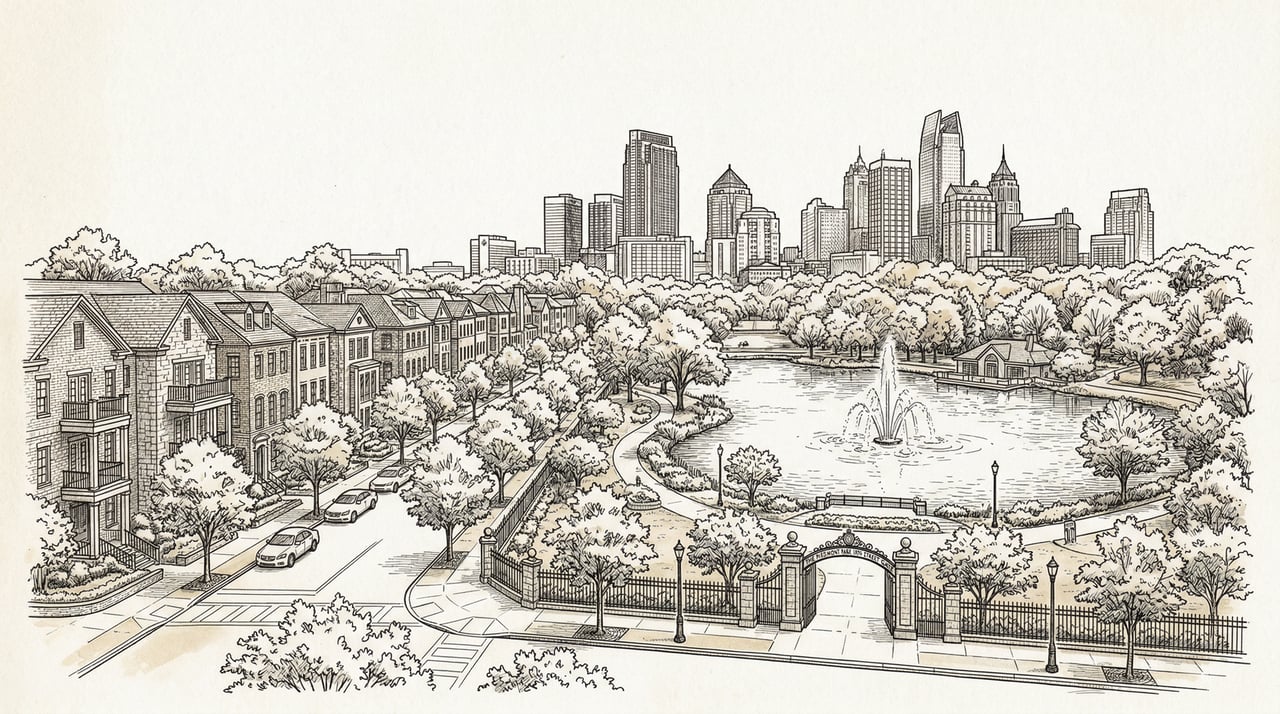
The Piedmont Park District sits at Midtown Atlanta’s eastern edge, where tree-shaded residential streets and carefully restored condominiums give way to one of the largest and most beloved urban green spaces in the American South.
Residents live within steps of the park’s winding trails, open meadows, and a quiet boating lake, with the Beltline’s Eastside Trail extending the neighborhood’s walkable reach well beyond Midtown’s borders.
The streets bordering the park, particularly Piedmont Avenue NE and 10th Street NE, are lined with historic apartment buildings, newer residential towers, and quiet corners where the pace slows despite the neighborhood’s central position in Atlanta.
Weekend mornings bring joggers to the park’s perimeter loop and longtime neighbors to the weekend market on Park Drive, creating a settled rhythm of outdoor life that feels both urban and deeply grounded.
Life in the Piedmont Park District centers on the park itself, which functions as an outdoor living room for morning walks, pickup sports, and long, unscheduled afternoons on the Great Lawn.
The Beltline’s Eastside Trail runs along the park’s southern edge, making it simple for residents to reach Ponce City Market, Krog Street Market, and Inman Park on foot or by bicycle.
The High Museum of Art and the Woodruff Arts Center are a short drive along Peachtree Street NE, giving residents both expansive outdoor space and world-class cultural institutions within easy reach.
Restaurants, wine bars, and specialty coffee shops populate the blocks surrounding the park, so evenings can move naturally from a park walk to a candlelit table within the same few square blocks.
Piedmont Park was established in the 1880s as grounds for the Piedmont Exposition, and the land later became Atlanta’s most enduring public green space after the city purchased and expanded it through the 1890s.
The Olmsted Brothers, the renowned landscape architects responsible for parks across the country, were engaged to plan improvements to Piedmont Park in the early twentieth century, lending the grounds a considered, classical character that still defines its layout.
Residential development in the surrounding blocks grew steadily through the early twentieth century, attracting apartment buildings and stately townhomes that reflected Midtown’s ambitions as Atlanta’s cultural and civic center.
By the mid-twentieth century, the park had become the emotional center of Midtown Atlanta, anchoring a neighborhood that grew increasingly layered in its architectural character and residential offerings over subsequent decades.
The Whole Foods Market on Ponce de Leon Avenue serves as the neighborhood’s daily anchor for organic and specialty provisions, with a morning coffee station and prepared foods section that residents fold seamlessly into their park routines.
Citizen Supply at nearby Ponce City Market anchors the retail circuit for design-minded residents, offering locally made goods, curated apparel, and home accessories that reflect the distinct aesthetic of this part of Atlanta.
Life Time on Spring Street provides a full-service athletic club just a short drive away, while the park itself remains the neighborhood’s most beloved fitness destination, used daily for runs, yoga sessions, and open-air workouts of every kind.
What is the overall feel of Piedmont Park District?
The Piedmont Park District has a rare combination of genuine walkability and genuine calm, drawing residents who want Midtown’s energy with room to breathe. The park is not a backdrop here — it is the defining feature around which the neighborhood’s entire identity is organized and daily life is shaped.
What home styles are most common here?
The district offers pre-war apartment buildings, mid-century brick condominiums, and newer glass-and-steel towers with skyline views — single-family homes are scarce, making this a neighborhood best suited to those who prefer vertical living close to an irreplaceable park setting.
What makes Piedmont Park District appealing for lifestyle buyers?
Immediate park access, Beltline connectivity, and proximity to Midtown’s cultural institutions make this neighborhood unusually complete for those who value an active, outdoor-oriented life. Dining, recreation, arts, and green space all exist within the same comfortable, walkable radius.
What does a typical day look like in Piedmont Park District?
A morning might begin with a run along the park’s perimeter path, followed by coffee on 10th Street or Ponce de Leon Avenue before heading into Midtown for work or errands. Evenings often return to the park’s Great Lawn or a nearby restaurant for a calm, unhurried dinner close to home.
Is Piedmont Park District a strong long-term ownership or investment choice?
Properties near Piedmont Park attract consistent buyer interest, given the combination of irreplaceable green space, cultural proximity, and Midtown walkability. Continued Beltline investment and surrounding Midtown development reinforce this area’s long-term appeal for both owner-occupants and investors who understand the value of scarcity.