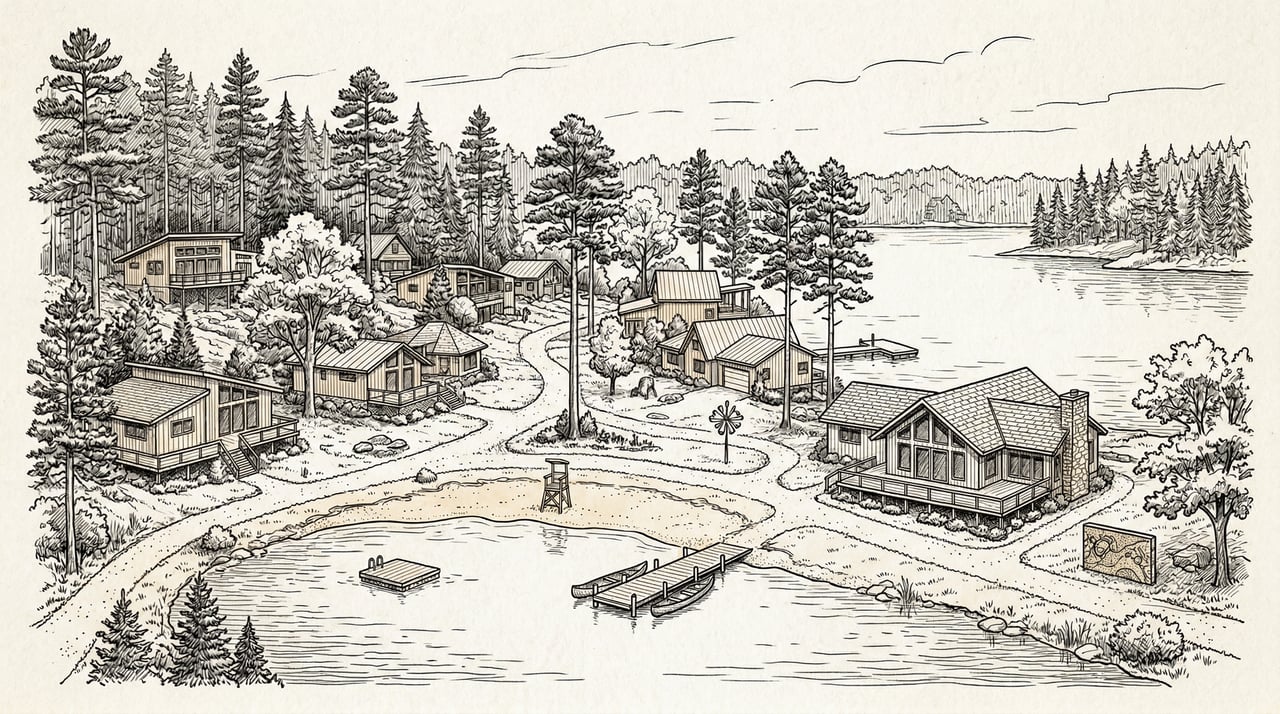
Pine Lake is one of the smallest incorporated cities in Georgia, a pocket community of a few hundred acres in DeKalb County where the namesake lake forms the visual and social center of a genuinely tight-knit neighborhood.
The homes here sit close to the water and to each other, arranged on narrow lots and winding lanes that give the city a scale more reminiscent of a lakeside village than a suburban municipality within 20 miles of downtown Atlanta.
The city's arts identity, cultivated over decades by residents who have deliberately shaped its culture, sets Pine Lake apart from every comparable community in the metro, attracting buyers who prioritize creative life alongside residential privacy.
The corridor along Hugh Howell Road provides easy access to the broader Tucker and Stone Mountain commercial areas, anchoring Pine Lake in the practicalities of daily life without diminishing its own distinctive, self-possessed character.
Life in Pine Lake organizes itself around the lake, the arts, and the small-scale social rituals of a community where nearly everyone knows their neighbors by name and front yards serve as an extension of shared social space.
The city has a long tradition of public art installations, sculpture gardens, and community-organized creative programming that gives its streets a visual richness and a sense of ongoing cultural investment unusual in any city of its size.
Kayaking and swimming in the lake during the warmer months, informal block gatherings, and the kind of unscheduled neighborly interaction that larger communities have largely lost all define the texture of a typical Pine Lake week.
Residents who choose Pine Lake are generally looking for something specific — a place where community is not an aspiration but a daily reality, and where the physical setting reinforces the social one at every scale.
Pine Lake was incorporated in 1937, making it one of the older small-city incorporations in DeKalb County, and from its earliest decades the community attracted residents drawn to the combination of the lake, the natural setting, and the relative remove from Atlanta's expanding suburban grid.
The city's architectural stock reflects that history, with cottages and bungalows from the mid-20th century sitting alongside more recent additions that have respected the neighborhood's human scale and unpretentious material palette.
A deliberate arts identity began to solidify in the late 20th century as the community attracted sculptors, painters, and creative professionals who found in Pine Lake a setting that supported a slower, more contemplative approach to residential life.
The city's sculpture trail and its tradition of publicly sited artwork reflect that ongoing investment in cultural identity, creating a streetscape that rewards a slow walk and reveals something new with each season's change of light and foliage.
Dining and Local Favorites
>
Daily errands for Pine Lake residents flow naturally into the Tucker commercial corridor along Hugh Howell Road and LaVista Road, where a Publix and a Sprouts Farmers Market cover grocery needs and local coffee shops like Spiller Park Coffee provide a reliable morning ritual.
The Tucker retail area includes locally owned home goods shops, antique dealers, and small boutiques that suit the eclectic aesthetic sensibility of Pine Lake residents, offering a browsing experience that feels curated and community-rooted rather than generic.
Wellness options in the corridor include boutique yoga studios and small-scale fitness practices that match the city’s preference for personal, community-oriented services over large-format fitness centers, keeping the pace and scale of recovery in line with the rest of daily life in Pine Lake.
What is the overall feel of Pine Lake?
Pine Lake feels unlike anywhere else in Metro Atlanta — a genuinely small, arts-forward community where the lake is visible from many streets and the social life of the neighborhood happens in public, outdoors, and without much planning. The city’s scale and its creative culture create a sense of place that is intimate, visually distinctive, and deeply resistant to the homogenization that has affected most of the surrounding region.
What home styles are most common here?
The dominant home types in Pine Lake are mid-20th-century bungalows, wood-frame cottages, and lakefront homes on narrow lots close to the water’s edge, many of which have been expanded or renovated by artistically inclined owners over the years. The architectural character is eclectic and individual, with personal expression in exterior materials, garden design, and sculptural elements more common here than in any comparable suburban neighborhood.
What makes Pine Lake appealing for lifestyle buyers?
Pine Lake appeals to a specific kind of buyer — one who wants to live in a place with genuine social depth, an active arts culture, and a physical setting centered on a natural amenity, all within practical distance of Atlanta’s employment and cultural resources. The city’s rarity within the metro makes it particularly attractive to those who have already lived in larger, more anonymous suburban communities and found them lacking.
What does a typical day look like in Pine Lake?
A typical morning in Pine Lake might begin with a walk along the lake path, a stop at a nearby Tucker coffee shop, and an afternoon spent in a home studio or garden before neighbors gather informally near the water as the light softens. The city’s small scale means that a good deal of social life happens organically, without reservation or planning.
Is Pine Lake a strong long-term ownership or investment choice?
Pine Lake’s scarcity, its distinct creative identity, and its lakefront setting combine to create a residential market where supply is structurally limited and buyer demand tends to come from a self-selecting, committed pool of residents who stay for many years. That combination supports long-term ownership value for buyers who understand what makes the city singular and who are prepared to participate in its community life.
915 people live in Pine Lake, where the median age is 41.5 and the average individual income is $42,231. Data provided by the U.S. Census Bureau.
Total Population
Median Age
Population Density Population Density This is the number of people per square mile in a neighborhood.
Average individual Income
There's plenty to do around Pine Lake, including shopping, dining, nightlife, parks, and more. Data provided by Walk Score and Yelp.
Explore popular things to do in the area, including Take It in the Face Sweetshop, and Serenede Nail.
| Name | Category | Distance | Reviews |
Ratings by
Yelp
|
|---|---|---|---|---|
| Dining | 0.24 miles | 0 reviews | 0/5 stars | |
| Beauty | 0.06 miles | 0 reviews | 0/5 stars | |
|
|
||||
|
|
||||
|
|
||||
|
|
||||
|
|
||||
|
|
Pine Lake has 441 households, with an average household size of 2.07. Data provided by the U.S. Census Bureau. Here’s what the people living in Pine Lake do for work — and how long it takes them to get there. Data provided by the U.S. Census Bureau. 915 people call Pine Lake home. The population density is 3,857 and the largest age group is Data provided by the U.S. Census Bureau.
Total Population
Population Density Population Density This is the number of people per square mile in a neighborhood.
Median Age
Men vs Women
Population by Age Group
0-9 Years
10-17 Years
18-24 Years
25-64 Years
65-74 Years
75+ Years
Education Level
Total Households
Average Household Size
Average individual Income
Households with Children
With Children:
Without Children:
Marital Status
Blue vs White Collar Workers
Blue Collar:
White Collar: