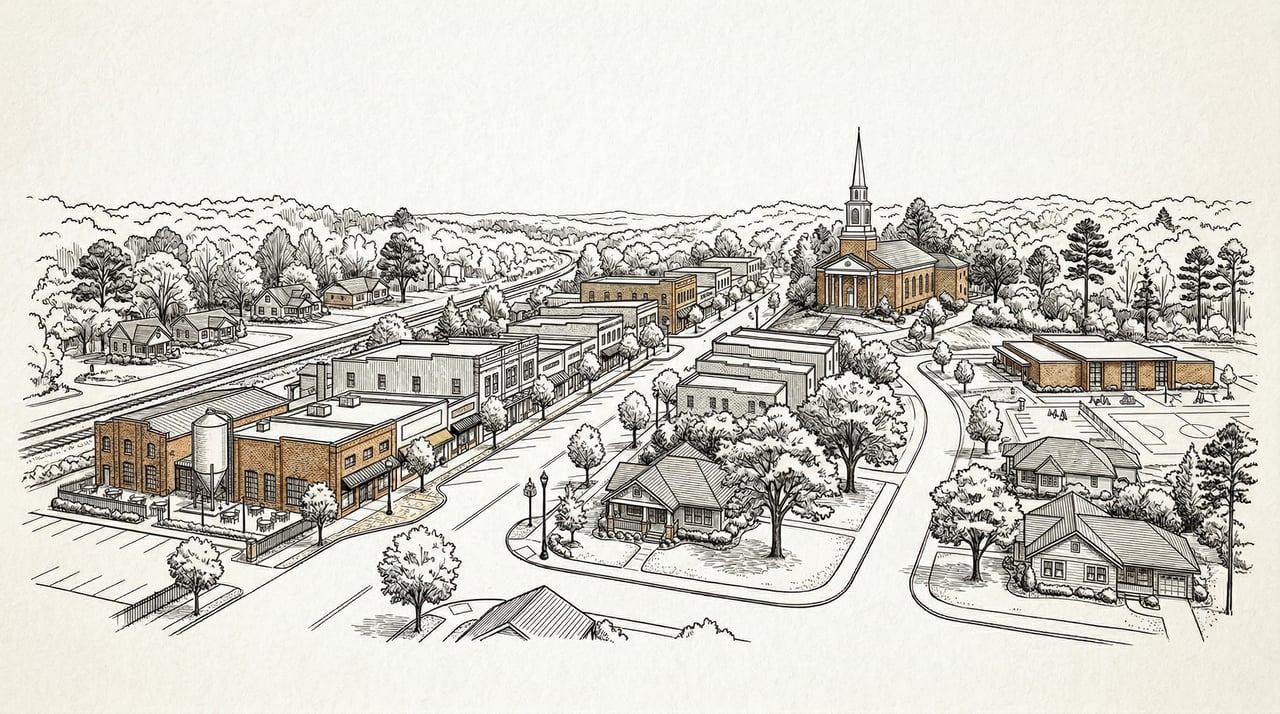
Tucker occupies a well-established pocket of eastern DeKalb County, its identity anchored by a compact Main Street, a canopy of mature trees, and neighborhoods of craftsman bungalows built across several decades.
The city was incorporated in 2016, but Tucker’s residential culture long predated that formal step, shaped by homeowners who chose its walkable grid and easy I-285 access over newer exurban developments farther out.
Main Street serves as the functional and social center, where independent restaurants, coffee shops, and local retailers line the sidewalks within easy walking distance of the craftsman-era homes on surrounding side streets.
Architectural variety spans from 1940s ranch houses to renovated mid-century contemporaries, with recent infill construction that respects the neighborhood’s established lot sizes and the residential scale its long-term residents value.
Tucker rewards a slow-paced, neighborhood-centered life built around a morning coffee walk to Main Street, weekend visits to the park, and the kind of social fabric that develops when neighbors share sidewalks for years.
Henderson Park and the Tucker Nature Preserve offer accessible green space within minutes of any neighborhood address, giving the city a greener, more natural feel than many of its DeKalb County neighbors.
The restaurant and bar scene on Main Street skews toward the independent and locally rooted, a collection of owners who know their regulars by name and build menus that reflect real community preferences.
Stone Mountain Park, just a few miles to the east, provides a vast outdoor extension of what Tucker’s parks system already offers, drawing hikers, cyclists, and families throughout the warmer seasons.
Tucker developed in the early twentieth century as a railroad and crossroads community along the Southern Railway line, with commercial activity concentrated near the depot on what became the present-day Main Street.
Post-World War II growth brought a wave of ranch homes and bungalows as Atlanta’s population spread into DeKalb County, giving Tucker its characteristic residential texture of modestly scaled, well-kept homes on generous lots.
For decades Tucker functioned as an unincorporated community within DeKalb, and local civic identity remained centered on Main Street institutions, churches, and neighborhood associations rather than any formal municipal structure.
Formal incorporation in 2016 gave Tucker its own government and accelerated investment in Main Street, though the neighborhood’s essential character, rooted in its architectural heritage and long-tenured residents, remained fully intact.
Daily grocery needs are supported by a full-service Publix near the Main Street area, while independently owned coffee roasters and cafes along the walkable Main Street corridor anchor the morning routine for locals who treat the sidewalk as a regular daily commute.
The Main Street retail environment supports a collection of locally owned shops and independent specialty stores that give Tucker a commercial identity distinct from the standard suburban strip-mall format found along the wider Lavista Road corridor.
Fitness studios, yoga providers, and small-scale wellness operators along Main Street and its adjacent corridors have expanded noticeably, reflecting broader demand from a younger and more health-oriented residential base drawn by recent Main Street investment.
What is the overall feel of Tucker?
Tucker carries the relaxed confidence of a community that has known what it is for a long time, with a Main Street culture and bungalow-lined streets that reward a walkable, neighborhood-first lifestyle. Residents describe it as one of the more genuinely local-feeling places inside the I-285 perimeter, with a social texture shaped by independent business owners and long-term homeowners who chose to stay.
What home styles are most common here?
Tucker’s housing stock centers on craftsman bungalows, mid-century ranch homes, and post-war cape cods built across several decades of steady residential development along the Main Street and Lavista corridors. Renovated examples on the established side streets are common, and recent infill construction has added contemporary homes that maintain the neighborhood’s lot sizes and tree canopy without disrupting its architectural rhythm.
What makes Tucker appealing for lifestyle buyers?
Tucker appeals to buyers who value walkability, independent commerce, and a neighborhood that feels rooted rather than recently assembled near the I-285 perimeter. The proximity to Stone Mountain Park, the mature tree canopy, and a Main Street that rewards foot traffic make it one of the more livable addresses in eastern DeKalb County for buyers seeking intown adjacency.
What does a typical day look like in Tucker?
A typical Tucker morning begins with a walk to Main Street for coffee, perhaps followed by the farmers market on the right weekend and a stop at one of the independent shops that line the sidewalk. Evenings settle naturally into the taproom at Tucker Brewing Company or a neighborhood dinner that rarely requires a reservation or a long drive to reach.
Is Tucker a strong long-term ownership or investment choice?
Tucker’s proximity to the I-285 perimeter, its established residential character, and its active Main Street redevelopment make it a compelling long-term ownership choice in a market where intown adjacency carries consistent demand. Incorporation has accelerated both commercial investment and residential renovation activity, supporting the neighborhood’s long-term ownership and appreciation appeal.